Fitnit Lab · built in public · measured 27 Aug 2026
What it takes
to compete
Seventeen apps that own the Health & Fitness category, pulled live from the App Store — every screenshot, subtitle, price, rating count and release date — beside Fitnit's real install numbers from PostHog. Then the part that actually matters: which of their advantages are buyable, which are structural, and what the honest sequence looks like from 17 installs a week.
01Where we actually are
Every plan below has to survive this table first. The gap is not a percentage.
median, 18 wks
median
at 4.2★
of 10 slots
the store
per month
since dec 2024
in the last 30 days
Installs have been flat-to-slightly-up all summer — 14, 16, 21, 16, 9, 13, 14, 14, 14, 20, 18, 22, 11, 17, 16, 28, 21, 17. Shipping 90 versions in five months moved product quality a long way and moved installs almost not at all, which is the single most useful fact on this page: we do not have a product problem in the funnel we can see, we have a distribution problem upstream of it. Signups track installs almost 1:1 (17 installs → 8–23 signups per week, helped along by the web app), so the store page is converting the handful of people who reach it. Almost nobody reaches it now — see the correction below, because that has not always been true.
02The 5,017 we already have
Every number in this section is a direct count from our own Postgres, not an estimate and not a proxy. It is the most important section on the page and it did not exist in the first draft.
created
121 are apple relay
anything at all
in 90 days
30 days
all time
What the shape says
- Something worked, for four months, and then stopped. May, June, July and August 2025 brought 1,369, 996, 1,044 and 633 accounts — 4,042 people, 81% of everything we have ever had, at roughly 1,000 a month. Today's rate is ~70 a month. Whatever that channel was, it produced 13× our current acquisition and it has been off for a year.
- They were real people, not a bot wave. 88% arrived through Google sign-in and 30–40% of each of those cohorts logged real data — a workout, a meal, a weigh-in, a step day. A scripted signup wave does not eat lunch and record it.
- The product kept almost none of them. 1,659 people used Fitnit at least once and 78 have opened it in the last month. That is a ~1.6% surviving fraction of everyone who ever signed up.
- Activation is climbing again, on tiny volume. The 2026 cohorts run 7–14%, then 30.3% in July and 46.3% in August — the best months since the 2025 wave, and they are the Apple-sign-in iOS cohorts. The current product converts arrivals far better than the 2025 product did. There are just eighty of them.
- The social layer never formed. Across 5,017 accounts: 3 friendships, 8 posts, 1 referral code. We built a feed, DMs, reactions, challenges and a referral programme for a network that does not exist yet. Nothing is wrong with the code; there was never enough simultaneous density for a second person to be there.
What the list is actually worth
4,895 mailable addresses is not one asset, it is three, and they want completely different emails:
| Segment | Size | What they did | The one email they get |
|---|---|---|---|
| Dormant activated | 1,589 | Logged real data at least once, then went quiet 90+ days ago | The one worth sending. "You tracked meals on Fitnit last year. It is an iPhone app now, and it counts your reps with the camera." Their data is still there — say so. |
| Signed up, never used | 3,259 | Created an account and bounced | A weaker list, and the one that will generate the spam complaints. Send last, in small batches, or not at all. |
| Currently active | 78 | Opened Fitnit in the last 30 days | Not a marketing list. These are the 78 people who can leave the first honest App Store ratings. |
| Apple private relay | 121 | Signed in with Apple, hid the address | Deliverable only while they keep forwarding on. Push notifications reach them; nothing else reliably does. |
mailto:; this needs the real sending path, and that decision is now urgent rather
than deferred.
And one live channel, already running
Search Console, the only attributed traffic we have, since it started recording in June 2026:
| Month | Impressions | Clicks | CTR |
|---|---|---|---|
| June 2026 | 17,625 | 92 | 0.52% |
| July 2026 | 115,176 | 367 | 0.32% |
| August 2026 | 217,696 | 415 | 0.19% |
03The field, measured
Sorted by rating count — the closest public proxy for how many people are actually in each app. Note the second column: nearly everyone at the top has been on the store for six to seventeen years. The two exceptions are the interesting ones.
| App | On store since | Ratings | ★ | Shots | Price (US, read from the listing) | The one job it does |
|---|---|---|---|---|---|---|
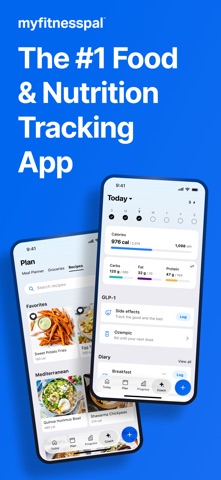
| MyFitnessPal | Dec 2009 16.7 yrs | 2,353,348 | 4.71 | 10 | $9.99–$19.99/mo $49.99–$79.99/yr | Log what you ate. Owns the food database everyone else licenses; bought Cal AI (closed Dec 2025). |
| Peloton | Feb 2014 12.5 yrs | 815,785 | 4.92 | 8 | $15.99–$28.99/mo $159–$289/yr | Follow a class with an instructor you like. Hardware halo + live leaderboard. |
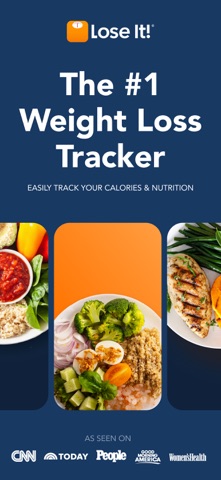
| Lose It! | Nov 2008 17.8 yrs | 773,795 | 4.77 | 10 | $39.99/yr $49.99 lifetime | Lose weight by counting calories. "The #1 Weight Loss Tracker", press logos in slot 1. |
| BetterMe | Aug 2017 9.0 yrs | 711,438 | 4.67 | 6 | quiz-priced not read | A plan built from a long onboarding quiz. Paid-social machine; the quiz is the funnel. |
| Nike Run Club | Sep 2010 15.9 yrs | 417,873 | 4.77 | 10 | free | Go for a run with a Nike coach in your ear. Brand as the entire acquisition strategy. |
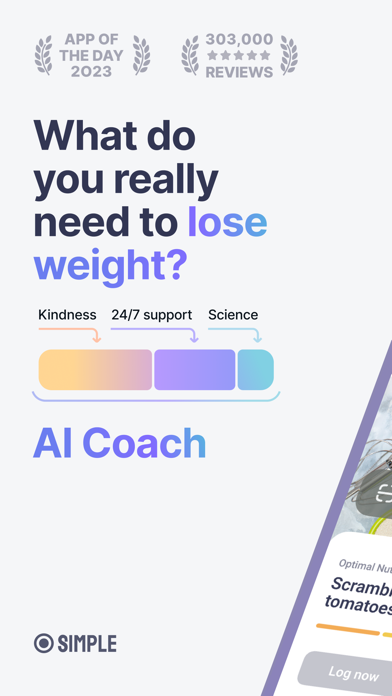
| Simple | Jun 2019 7.2 yrs | 397,915 | 4.69 | 9 | quiz-priced not read | An AI coach that talks to you about eating. "App of the Day 2023" badge in slot 1. |
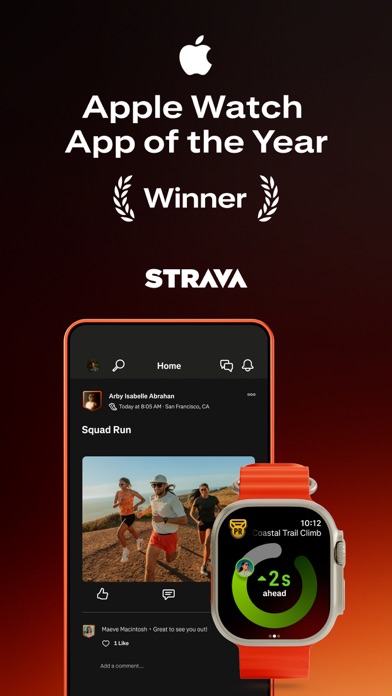
| Strava | Mar 2011 15.4 yrs | 370,029 | 4.81 | 10 | $11.99/mo · $79.99/yr + Runna bundle $149.99 | Your runs and rides, seen by your friends. 150M registered, ~2M signups/mo. Bought Runna. |
| Cal AI | Apr 2024 2.4 yrs | 359,229 | 4.80 | 4 | $29.99/yr $0.99 streak restore | Photograph food, get calories. Two founders, no funding, ~700k downloads/mo, ~$2M/mo. |
| Fitbod | Sep 2015 10.9 yrs | 282,352 | 4.81 | 10 | $12.99–$15.99/mo $79.99/yr | Tells you what to lift today, based on what you lifted before. Apple Editor's Choice. |
| StepsApp | Oct 2015 10.9 yrs | 292,950 | 4.81 | 9 | $4.99–$6.99/mo $19.99–$32.99/yr | Count steps. That is the whole app. #20 on the free H&F chart, 31 languages, ~500k downloads/mo. |
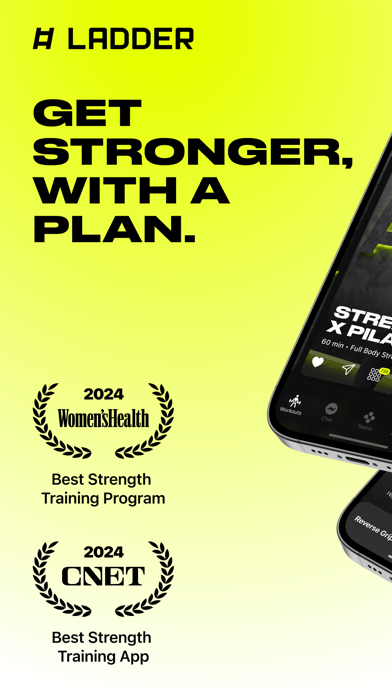
| Ladder | Jun 2020 6.2 yrs | 186,283 | 4.95 | 10 | $29.99–$49.99/mo $179.99–$479.99/yr | Train on a named coach's program with a team. #16 grossing in the category. |
| Strong | Sep 2011 14.9 yrs | 108,503 | 4.86 | 6 | $4.99/mo · $23.99/yr $79.99 forever | Log a barbell set fast. Almost no marketing; pure word of mouth for a decade. |
| Hevy | Jul 2019 7.2 yrs | 88,682 | 4.92 | 10 | $2.99/mo · $23.99/yr $74.99 lifetime | Log a lift, see the graph go up. "Join +10 million users! No ads and free." |
| Runna | Dec 2021 4.7 yrs | 33,402 | 4.85 | 10 | $19.99/mo · $119.99/yr | A training plan for the race you signed up for. Acquired by Strava. |
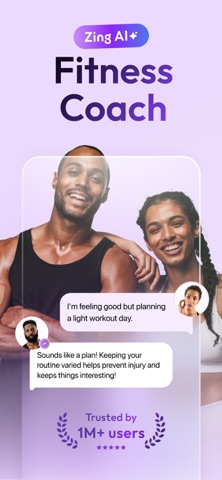
| Zing AI | Apr 2021 5.4 yrs | 30,733 | 4.77 | 9 | quiz-priced not read | AI body scan → a plan that adapts. "Trusted by 1M+ users" badge in slot 1. |
| Alpha Progression | Sep 2019 6.9 yrs | 2,123 | 4.92 | 8 | $12.99/mo · $79.99/yr | Hypertrophy programming for people who read the studies. Deliberately narrow. |
| Fitnit | Mar 2026 0.5 yrs | 5 | 4.20 | 5 | free + premium | Twelve jobs, listed in order, in a 3,900-character description. |
And the subtitle — 30 characters, one job each
Read straight off the live listings. Every one of them names a single job, in the buyer's own words, with no conjunction:
| App | Subtitle | What it commits to |
|---|---|---|
| Cal AI | Food & Macro Counter | Counting food. Nothing else. |
| Hevy | Weight Lifting Routine Planner | Lifting. Says the equipment out loud. |
| Runna | 5k to Marathon Training | Names the distance the buyer already has in mind. |
| Lose It! | Food Tracker for Weight Loss | Job + outcome, six words. |
| Strong | Strength Training Planner | Three words, zero adjectives. |
| StepsApp | Step Counter, Walking Tracker | Two synonyms for one job — the second is pure keyword, and it works. |
| Fitbod | AI Personal Trainer & Workouts | The one that leans on "AI" — and it has 282k ratings to carry it. |
| Strava | Track & share with friends | The network, not the tracking. |
| Alpha Progression | Weight-lifting Tracker Planner | Two nouns. No promise at all — it sells to people who already know. |
| MyFitnessPal | Workout & AI Nutrition Tracker | Broadened only after 16 years and 2.3M ratings. |
| Ladder | Fitness, Workouts, Coaching | Three nouns — a keyword field, not a sentence. The weakest one here. |
| Fitnit | Count Reps & Calories with AI | Two unrelated jobs joined by "&", and the second one belongs to MyFitnessPal. |
04Momentum, measured
Nobody publishes a download curve. Sensor Tower and Appfigures hold those behind a paywall, and every "growth chart" in a blog post is one of their estimates re-drawn. Two things are measurable for free, and between them they answer the question better than one estimate would.
What each app is doing right now
Apple publishes the most recent written reviews for any app as an RSS feed. Pull the 250 newest for each app, measure the span of time they cover, and you get a real number: how fast that app is accumulating written reviews today. Hevy's 250 most recent reviews span eight days. Alpha Progression's span five and a half years.
And what each one built, per year, to get here
The second measure is the lifetime average: total ratings divided by years on the store. It is a chord, not a curve — it cannot show a bad quarter or a viral month, and it flatters a young app while punishing an old one that has plateaued. Read as a record, not as a trend, it is still the clearest picture of who built fast.
Ours, on the same axis
This one is a real curve, because it is our own data and we can see all of it.
05What they actually make
Only Peloton has to publish real numbers. Everything below is either a company statement or a third-party estimate, dated per row — order of magnitude, not accounting.
| App | Downloads / mo | Revenue / mo | Per download | What it is |
|---|---|---|---|---|
| Strava | — | ~$35–42M | — | $415–500M/yr reported; filed confidentially for a US IPO in Feb 2026 at a $2.2B valuation. |
| Ladder | — | ~$8M | — | Raised $105M; publicly targeting $100M ARR by early 2026. Statista puts it #1 worldwide by in-app revenue. |
| Cal AI | ~700,000 | ~$2,000,000 | $2.86 | Third-party estimate, Apr 2026. ~$40M ARR reported before the MyFitnessPal acquisition. |
| Fitbod | ~200,000 | ~$2,000,000 | $10.00 | Third-party estimate, Mar 2026. The best monetisation per install on the page, at $79.99/yr. |
| BetterMe | ~400,000 | ~$600,000 | $1.50 | Third-party estimate — but dated Nov 2024, so treat it as the weakest row here. |
| StepsApp | ~500,000 | ~$400,000 | $0.80 | Third-party estimate, Mar 2026. The cheapest install on the page, and half a million of them a month. |
| Hevy | — | $20,000 in 2023 | — | Last public figure ($240k ARR, bootstrapped). Now claims 10M users — the number is certainly stale, and nobody has published a newer one. |
| Peloton | — | public co. | — | App tiers $15.99–$28.99/mo. The only company here whose numbers are audited. |
| MyFitnessPal, Lose It!, Simple, Runna, Strong, Zing, Alpha | — | not public | — | Estimates exist behind Sensor Tower / Appfigures paywalls. We are not going to guess at them here. |
| Fitnit | ~74 | — | — | 17 installs a week. The revenue question is not yet the interesting one. |
The number worth stealing: what one install is worth
Where both figures exist, dividing them gives the only cross-app benchmark on this page that is directly usable by us — and the spread is twelve-fold:
- Fitbod — $10.00 per download. $79.99/yr, a narrow high-intent audience, and an app that is useless without the subscription. Fewest downloads of the four, most revenue.
- Cal AI — $2.86 per download. $29.99/yr against enormous volume. The creator machine buys reach, and the low price converts it.
- BetterMe — $1.50 per download (2024). Quiz-priced, paid-social-fed.
- StepsApp — $0.80 per download. The thinnest monetisation here by far, and it still clears ~$400k a month, purely because half a million people a month download a step counter.
06What their first screenshot does
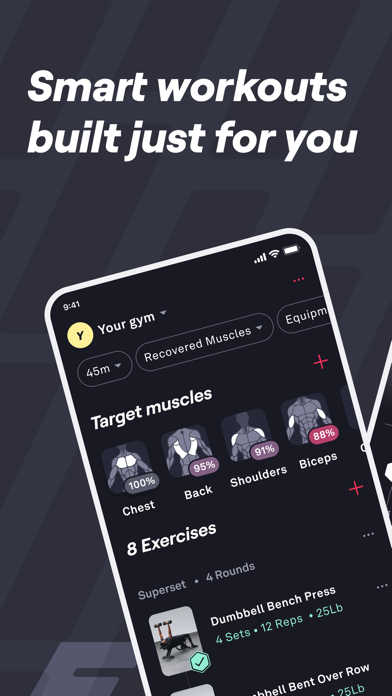
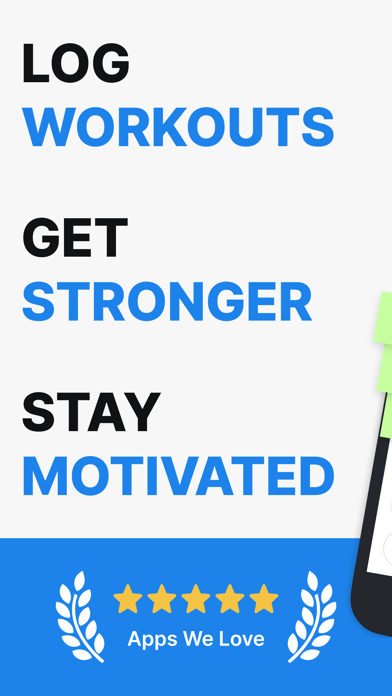
Apple's own data says the decision happens in about seven seconds and the first two screenshots carry most of the conversion. Here is slot 1 from eight of them, at the size a person actually sees it in search results.
Cal AI is the one to study, because it is the one we could actually copy
Four screenshots. Not ten. They are not a feature tour — they are one job, told as four consecutive beats, in one colour, in one typeface:
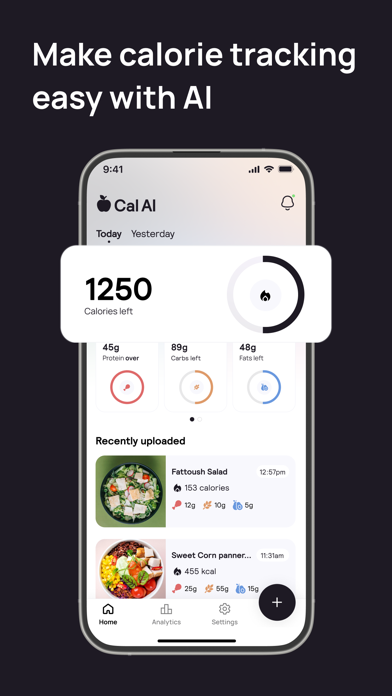

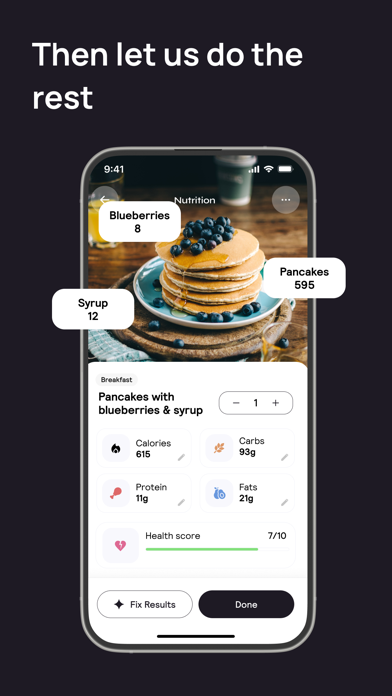
A 2.4-year-old app with two founders sits above Fitbod, Ladder and Strava on rating count with four screenshots and one sentence of positioning. Whatever else is true, the store listing is not where their advantage lives — and it is not where ours is lost either. But it is the cheapest thing on this page to fix.
StepsApp: the narrowest job in the category, and #20 on the free chart
Worth its own look, because it is the counter-example to everything Cal AI teaches. No AI, no coach, no plan, no creator budget — it counts steps, a thing iOS already does for free, and it has 292,950 ratings at 4.81★, sits at #20 on the US free Health & Fitness chart, ships in 31 languages, and claims 100 million people in the first line of its description.
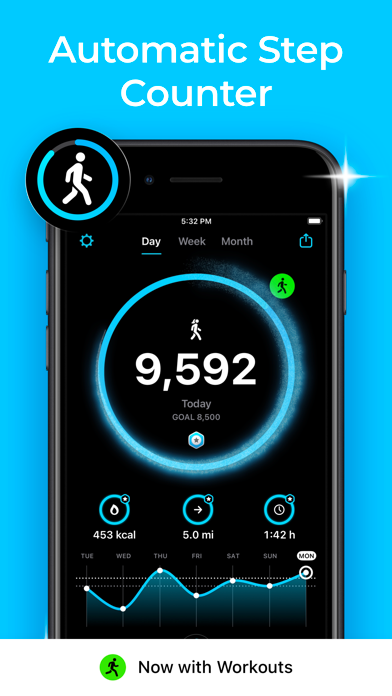
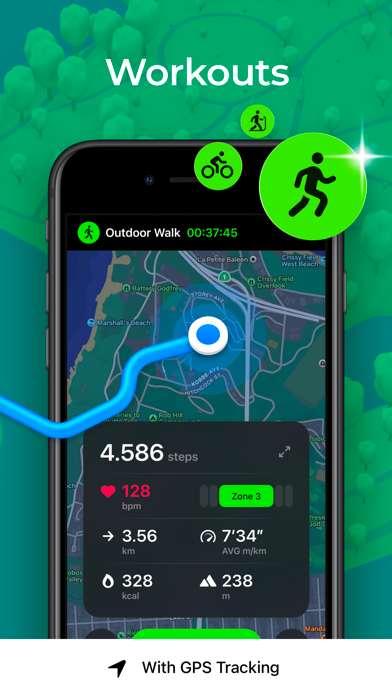
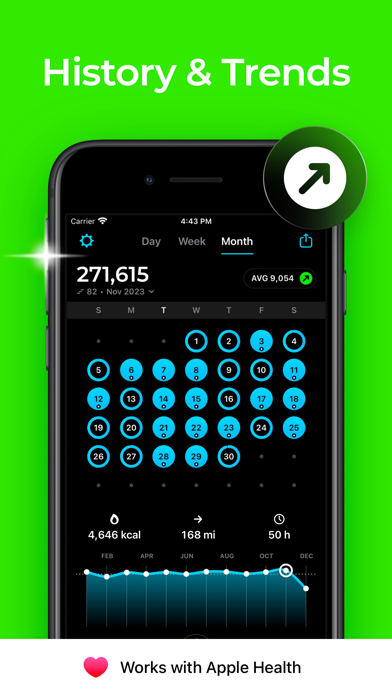
- It is beating its own niche 30:1. Pedometer++ has 180,782 ratings and 0.87 reviews/day; StepsApp has 26.92. Being in a big category is not the advantage — out-executing inside it is.
- It monetises worse than anything else on the page and earns more than most. $0.80 per download × ~500k downloads a month. Volume is doing every bit of the work.
- Its recent additions are our existing features. Streaks, challenges with friends, leaderboards, groups, Apple Health, widgets. A pedometer bolting on social — while we have the social and bury the steps.
- The uncomfortable read: "count my steps" is a job millions of people search for and instantly understand; "count my reps with the camera" is a job almost nobody searches for yet. StepsApp wins a commodity with volume. We cannot — entering that category means starting at #200 behind a ten-year incumbent at #20. The rep counter is the opposite trade: tiny demand, no incumbent, and a demo that plays as video.
07Ours, honestly
Same treatment, same scale, no defending it.
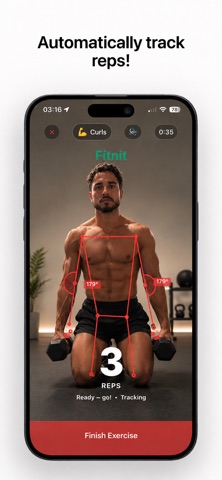
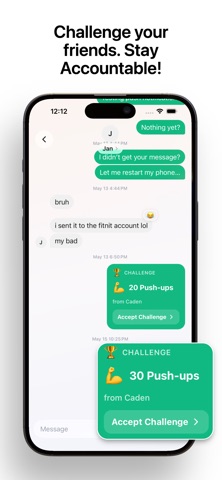
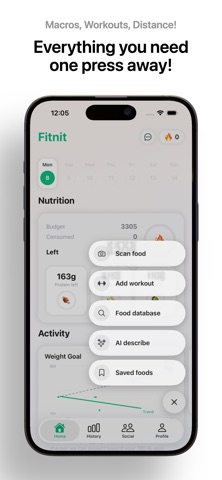
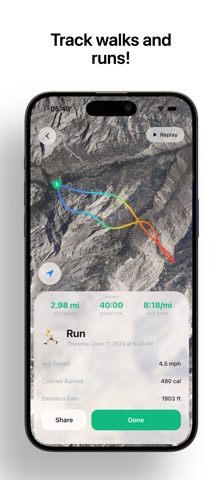
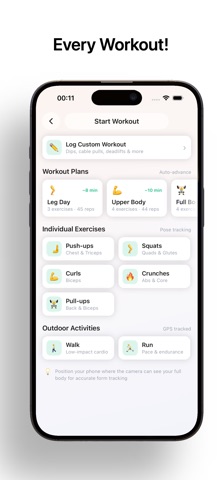
- Five slots of ten used. The unused five cost nothing and are worth more than any feature we could ship this month.
- No proof of any kind. No award, no review count, no user count, no press. Partly because we have none yet — which is what makes the ratings number in §01 a marketing problem, not a vanity one.
- No owned colour. Red, green-on-white, white, dark map, white. Nothing about the row is recognisable at thumbnail size.
- Every caption ends in an exclamation mark and names a feature. "Automatically track reps!", "Every Workout!", "Track walks and runs!". Nobody in §03 does this.
08The positioning problem, in one measurement
The app is called Fitnit: AI Rep Counter. Here is where it sits for the terms that name it (iTunes Search API, US, 27 Aug 2026 — directional, not App Store search rank):
| Search term | Fitnit position | What's there instead |
|---|---|---|
| rep counter | not in top 50 | RepCount (13,107 ratings), Strong, and three 0-rating apps published in 2026 |
| ai rep counter | 23 | Twenty-two apps ahead of us for our own product category name |
| pushup counter | not in top 50 | Push Up Counter & Tracker (3,256 ratings), PushFit (2,318) |
| squat counter | not in top 50 | — |
| fitnit | 2 | Google Health (Fitbit) outranks us on our own brand name |
Our keyword field is workout, calorie, food tracker, gym, weight loss, personal trainer,
macros, barcode, squat, pushup, form, diet — twelve head terms, each defended by an app
with six figures of ratings and a decade of downloads. Not one of them is winnable, and the
long-tail terms we could win are being spent on instead.
09How the big numbers were actually bought
Four playbooks, sorted by whether we can run them.
Creator volume — Cal AI
copyablecash + a lot of DMs- ~250 creators on monthly retainer across TikTok and Instagram, each with a referral code so they have a stake in installs, not just views.
- Volume, not selection: message 500 creators, ~50 reply, ~10 post. They scaled that to thousands of messages.
- Founder-led content on top of it — the founder's own TikToks were the first channel.
- Result: from launch (Apr 2024) to ~700k downloads and ~$2M/month, bootstrapped, then acquired by MyFitnessPal.
Coaches as product and channel — Ladder
partly copyablerelationships- Named coaches run the programs inside the app, and the same coaches make the content that sells it. Link-in-bio → a landing page about that coach → the app.
- Best organic posts get promoted into paid ads on TikTok and Meta.
- An onboarding quiz predicts each signup's LTV; ad spend is optimised against the prediction, not against installs.
- They also halved the price, $60/mo → $30/mo, when the first number blocked growth. Coach partnerships alone got them to $1M ARR; ~500% growth followed.
Product-led patience — Hevy, Strong, Alpha Progression
copyable, slowyears- Hevy: free, no ads, 4.92★ from 88,682 ratings, $23.99/yr, "+10 million users" as the opening line of the description. Seven years.
- Strong: fourteen years, almost no marketing, 108k ratings. Word of mouth, one job done exceptionally.
- Alpha Progression: deliberately narrow — hypertrophy programming for people who read the studies — 4.92★ and a small, loyal base.
One commodity job, 31 languages — StepsApp
copyable, wrong for uslocalisation- Pick a job everybody already understands and searches for by name, be free, and never widen the pitch. The subtitle is literally "Step Counter, Walking Tracker" — the job, then its synonym.
- 31 languages. The cheapest download volume available to a small team, and the thing almost no indie app bothers to finish. We ship 11.
- Monetise thin ($19.99–$32.99/yr) and let volume carry it: ~$0.80 per download × ~500k downloads/month.
- Add the social layer after the volume exists, not before — challenges, leaderboards and groups arrived a decade in.
Brand, decade, acquisition — Strava, Nike, MFP, Peloton
not copyable—- Strava: 150M registered users, ~2M new signups a month, 15 years, and it just bought Runna.
- MyFitnessPal: 200M registered, owns the food database competitors license — and bought Cal AI outright (closed Dec 2025).
- Nike and Peloton: the app is a retention surface for a brand built elsewhere.
What paid would cost, before we consider it
| Input | Benchmark | What it implies for us |
|---|---|---|
| Apple Ads CPI, H&F | ~$3–5 | $1,000/mo buys ~200–330 installs — about 3× our current total volume |
| Custom Product Pages | +12% taps/impr, +9.6% installs/tap | ≈ 23% more installs on identical spend. We currently run zero CPPs |
| Product-page conversion, H&F | ~48% median | Our 5 ratings and 5 screenshots put us well under this — paid traffic would be taxed at the door |
| Install → paid, onboarding trial paywall | ~1.78% | 330 paid installs ≈ 6 subscribers/mo. Paid does not work until CPP + listing are fixed |
| D30 retention, H&F | 5% median, 8–12% good | The number that decides whether any of this compounds. We have not measured ours |
| Monthly subscription churn | ~9.2% | Annual plans retain 40–60% better — matters for the July repricing already planned |
10The plan
Sequenced so each phase makes the next one cheaper. Each has a test that can fail.
Phase 0 — Use the 5,017 we already have
this weekan ESP, and warm-up time- Find out what drove May—Aug 2025. One question, one answer, and it either hands us back a thousand signups a month or rules it out. Nothing else on this page has that ratio.
- Stand up real sending — the SES path already sketched for support mail — on a subdomain, warmed on the 78 actives first.
- Email the 1,589 dormant activated users. Their data is still in the database, which is the strongest opening line available: their meals and weigh-ins are waiting, and the thing they signed up to is now an iPhone app that counts reps through the camera.
- Ask the 78 actives for a rating, individually and by hand. Not a prompt — a message. Five ratings is the number blocking every other lever on this page, and there are seventy-eight people who can move it this week.
- Leave the 3,259 never-activated addresses alone until the first two sends have a deliverability record.
Phase 1 — Make the page worth arriving at
this weekno budget- Ten screenshots, one narrative, one colour. Copy Cal AI's structure with our own job: open the camera → put the phone down → it counts and calls out form → the week's muscle map → the numbers going up. Slot 1 is a claim, not a feature label. Kill the DM thread and the menu.
- Get past five ratings. The native review prompt, fired after a successful tracked set — the moment the product has just visibly done the impossible thing — not after a workout summary. Everything downstream is gated on this number.
- Rewrite the subtitle. "Count Reps & Calories with AI" splits the claim in two and puts us in a fight with MyFitnessPal on the second half. Pick the half nobody is defending.
- Rewrite keywords to the long tail we can actually rank for — rep counting, form check,
push-up counter, camera trainer — and stop spending characters on
diet,gymandweight loss. - Cut the description's first 400 characters down to one job. Twelve features listed in order is what an app with no positioning looks like.
Phase 2 — Pick the one job and say only it
2–4 weeksno budget- The recommendation is the camera. It is the only thing in our feature list that no app with real distribution is defending (§05), it is already in our app name, it is the only screenshot in the category showing a phone watching a person, and — decisively — it is the only feature whose output is a video someone would post.
- The other eleven features do not get deleted. They stop being the pitch. Hevy has social, plate calculators and Strava sync; the store page says "log workouts, get stronger".
- Custom Product Pages per intent once the base listing is rebuilt — one for rep counting/form, one for nutrition, one for run tracking. This is the 23% install lift, and it also lets the nutrition and running stories keep selling without diluting slot 1.
Phase 3 — Turn the product's output into the ad
4–10 weeksbuild + seeding- Ship a one-tap vertical video export of a tracked set — the recording with the skeleton overlay, the rep count ticking, the form score, the Fitnit mark. Right now a workout ends in a share card; it should end in a nine-second clip. This is the single highest-leverage build on the page, because it is the thing Cal AI had for free.
- Seed creators the Cal AI way, at our scale. Not 250 on retainer — 50 outreach messages a week to micro-creators in calisthenics, home workouts, military/PT prep and 75 Hard, offering a referral code. We already have Refer & Earn and the Affiliateo rails built, which is a real head start most apps do not have at this stage.
- Founder-led posting, non-negotiably. Cal AI's and Ladder's first channel was the founders. Post the rep counter working. Post it failing. The lab pages are already this voice.
- Promote whatever organic post outperforms into paid, Ladder-style — not new creative.
Phase 4 — Only now, buy
after 1–3 land$500–1,000/mo- Apple Ads on the long-tail terms we already rank for organically, pointed at the matching Custom Product Page.
- Instrument install → trial → paid before spending, and hold it against the 1.78% benchmark.
- Make onboarding predict LTV (Ladder) so spend optimises to value, not to installs.
11The scoreboard
Six numbers. If these do not move, nothing above worked, regardless of how much shipped.
| Metric | Today | First target | Why this one |
|---|---|---|---|
| App Store ratings | 5 | 25 → 100 | Gates the conversion of every other channel. Cheapest number to move. |
| Screenshot slots used | 5 / 10 | 10 / 10 | Free inventory, currently half empty. |
| Custom Product Pages | 0 | 3 | ~23% more installs on identical traffic. |
| Installs / week | 17 | 50 → 150 | The actual objective. 3× is a listing fix; 10× needs Phase 2. |
| Dormant users re-reached | 0 of 1,589 | 1 send | The only audience we already own. Costs an ESP and an afternoon. |
| 30-day actives | 78 | 300 | The number the whole product is judged on, and the sample every conversion rate must come from. |
| Organic clicks / mo | 415 | 1,500 | On 217,696 impressions already being served. A CTR job, not a ranking job. |
| Written reviews / day | 0.04 | > 1.0 | The category pulse, measured the same way for every app above. Alpha Progression sits at 0.12. |
| D30 retention | unmeasured | > 8% | Decides whether installs compound or leak. Median is 5%. |
| "rep counter" position | not in top 50 | top 10 | The one term we should own outright, in our own app name. |
Sources — iTunes lookup & search API
(metadata, positions, 27 Aug 2026) · US App Store product pages (subtitles, IAP pricing) ·
PostHog (installs, signups, actives; 18 weeks to 23 Aug 2026) · our own Supabase Postgres (accounts, activation, segments, Search Console rollups; counted 27 Aug 2026) ·
AppTweak and
Adapty Apple Ads benchmarks 2026 ·
Business of Apps
H&F benchmarks · Sub Club
on Ladder · Starter Story on Cal AI.
Rating counts are a proxy for scale, not a download report. Keyword positions are the iTunes
Search API, which ranks differently from App Store search — read them as direction, not as rank.
Regenerate: python3 scripts/lab/externalize.py compete.html --out src/public/lab --name compete